


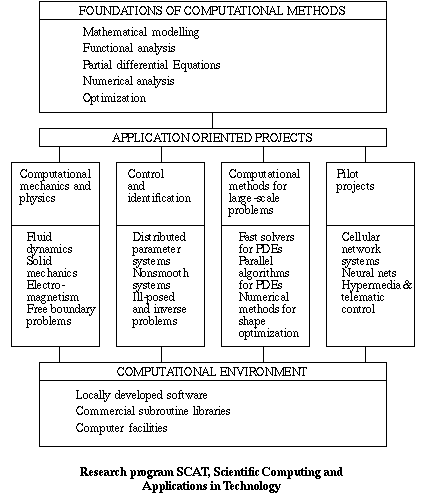
The research projects have been organized in the SCAT (Scientific Computing
and Applications in Technology) program. The SCAT program consists of projects
in five main research areas. In the year 1993 these areas have been
- foundations of computational methods,
- computational mechanics and physics,
- control and identification,
- computational methods of large-scale systems, and
- pilot projects.
Within each research area a reasonable level of synergy between different
projects is generally provided either by use of similar methods or by study of
similar problems with different types of methods.
The different research areas have a common mathematical background which
makes the communication possible also between projects in different areas. Moreover, much effort has been invested in the common computational environment
which on the one hand reduces the routine work in the projects and on the other
hand makes it easier for the projects to communicate with each other.
Although many of the projects deal with fundamental questions, the main emphasis is in most of them in some special problems. That is why only relatively
few projects can be considered to belong to this category.
Finite Element Methods and Applications (MICHEL KRÍZEK, RAINO A.E. MÄKINEN, PEKKA NEITTAANMÄKI, VALERY RIVKIND and TIMO TIIHONEN)
The project deals with finite element analysis of some important, mostly nonlinear, problems. The goal is to give a rigorous analysis for the theoretical background
of these questions. Of course, it is not possible to cover all technically interesting
cases. Nevertheless, several typical techniques are introduced for solving nonlinear
problems which can then be modified for other problems. There is no general numerical method capable of solving an arbitrary nonlinear problem and, therefore,
every class of problems has to be investigated individually. The investigation of
nonlinear problems consists of several steps. The problem is split into a series of
subproblems, including, as a rule, the proof of the existence (and, if applicable,
also uniqueness) of the true solution, the construction of concrete finite elements,
the treatment of convergence questions together with the numerical solution of the
approximate problem. Among others, Maxwell equations, contact problems, free
boundary problems, Stefan-like problems, crystal growth problems and problems
in elasticity and plasticity have been handled.
Research collaboration with researchers from Czech Republic, Germany, USA,
France, England, Italy, Poland, Russia and other universities in Finland.
This project consists of two parts. The first part deals with nonsmooth analysis and optimization. Subdifferential calculus has been applied to generalize the
optimization theory and especially the optimality conditions of nondifferentiable
functions. This theoretical basis has made it possible to develop effective bundletype optimization methods for nonsmooth and nonconvex objective functions subject to linear, nonlinear, nonsmooth and nonconvex constraints. The new variant,
called proximal bundle method has proved to be very efflcient and reliable in solving nonsmooth and also smooth optimization problems. The methods have been
implemented as a subroutine library and tested with standard test examples from
the literature in different environments (microcomputers, workstations, mainframe
and super computers).
The second part of the project deals with multiobjective optimization. The aim
has been to generate interactive optimization methods for complicated problems.
Two different kinds of interactive procedures have been developed for nonsmooth
multiobjective optimization. Some optimal control problems arising from optimal
shape design and continuous casting processes have been solved as applications.
Modelling and Simulation of Paper Making Process (RICHARD DU CROO
DE JONGH, JARI HÄMÄLÄINEN, KAI HILTUNEN, MATTI KURKI, TIMO TIIHONEN and
REIJO PIETIKÄINEN)
The goal of the project is to construct simulation models for some key parts of
a paper machine as well as to study the properties of paper.
Homogenization and dimensional reduction have been applied in order to obtain
a computationally feasible model for fluid flow in the headbox of a paper machine.
The model has been published in a PhD thesis and in some conference articles.
Also some numerical methods for predicting the shape of the free jet at the outlet
of the headbox have been developed.
Modelling of the so-called former section of a paper machine (where fluidlike
suspension of water and fibres gradually solidifies to a porous fibre net) has been
started. A part of this work has been undertaken at the Technical University of
Delft. Mathematical properties of the model are studied and numerical methods
are being developed.
In addition, a model has been derived for moisture induced deformation of
copying paper. The behaviour of paper sheets has been found to be strongly
nonlinear and to exhibit bifurcation phenomena. The model has also been tested
experimentally.
Free Boundary Problems (JAROSLAV HASLINGER, JARI JÄRVINEN, PEKKA NEITTAANMÄKI, VALERY RIVKIND and TIMO TIIHONEN)
Free boundary problems form one of the main research fields of the laboratory. In the past the work on free boundary problems and related control problems
initiated the research in nonsmooth optimization and in state constrained control
problems. Currently the laboratory takes part in the ESF programme Mathematical Treatment of Free Boundary Problems.
The theoretical work on free boundary problems concentrates now on modelling
the evaporation process. The goal is to find adequate free boundary conditions for a
coupled system of Navier-Stokes and Stefan equations as well as to develop suitable
techniques for mathematical analysis and numerical solution of such problems.
Another main line in the research is the use of techniques developed for shape optimization in solving free boundary problems and analysing the solution methods.
Often the free boundary conditions can be formulated as optimality conditions of
a shape optimization problem. The main emphasis has been on a method which
is based on a suitable relaxation of such a shape optimization problem.
There is also work going on in numerical simulation of an industrial process for
producing silicon crystals. A numerical model has been constructed which takes
into account all major mechanisms of heat transfer including solidification and
heat radiation.
In electromagnetism the goal has been to introduce efflcient and reliable methods for the synthesis of magnetic and electric fields. On a more concrete level
the research effort has been focussed on the forth-coming monograph "Inverse
Problems and Optimal Design in Electricity and Magnetism" (submitted for publication at the Oxford University Press). It collects material from optimization,
optimal design and inverse problems in a form that is applicable in the analysis
and development of electromagnetic systems.
The Bounding Approach of the Timing Simulation (CORNELIU A. MARINOV
and JUKKA-PEKKA SANTANEN)
The main performance criterion for digital circuits is the speed of the signal
propagation which can be expressed by a delay time. The calculation of the exact
transient solution is a very time consuming task especially in the early stages of the
design. Due to this, upper and lower bounds are used instead of the exact solution
in the so-called time simulators. The upper and the lower bound estimates for the
solution can be calculated by using the parameters of the circuit, but the achieved
bounds may not be tight enough. Another possible way of bounding the solution is
to use the Waveform Relaxation method which gives tightening monotonic bounds
for the solution when some special initial bounds for the solution have been defined.
The purpose is to discuss optimal control problems, especially systems arising from free boundary problems. The main interest has been in optimal control problems governed by nonlinear parabolic systems including, among others,
parabolic variational inequalities and systems with phase transitions. The aim
is twofold: firstly to give a theoretical approach to the subject and secondly to
present detailed algorithms (with convergence proofs) necessary in computerizing
the optimal control processes. Several practical examples are being worked out in
detail in order to demonstrate the usefulness of the proposed methods. The results
have been collected in the monograph "Optimal Control of Nonlinear Parabolic
Systems: Theory, Algorithms and Applications" (Marcel Dekker, Inc. to appear in
1994).
Collaboration with researchers from France, Germany, USA, Japan and Romania.
Optimization of Distributed Systems with Applications (TIMO MÄNNIKKÖ)
The main subject of this project is the theory of sentinels and their applications.
Sentinels are "filters" which are sensitive to the variations of some specific parameters, and at the same time insensitive to the variations of all the other unknown
parameters appearing in the system.
As an application, sentinels are used to identify unknown source terms in a
parabolic partial differential equation with incompletely defined boundary and/or
initial conditions.
This project is done in international co-operation with researchers from Compiègne University of Technology, France.
In this project hemivariational inequalities and optimal control problems governed by hemivariational inequalities are studied. An approximation of hemivariational inequalities has been developed. It can be realized numerically by using
nonsmooth optimization methods.
Also sensitivity analysis of optimal control problems is studied by using a regularization method and set-valued analysis.
The aim is to develop methods for the identification of a functional coefflcient.
It is assumed, that one has a distributed observation of the solution of an elliptic or
parabolic partial differential equation. These observations are used to determine
the unknown coefficient in the equation. In physical systems this parameter can
represent the heat conductivity or the diffusion coefficient.
Several different discretization schemes based on variants of finite element, spectral and multigrid methods are considered. In addition to new efflcient numerical
algorithms one of the purposes is the improvement of techniques for convergence
analysis of different approaches. At the moment there exist few error estimates for
parameter identification problems and only for elliptic equations. One of the goals
is also the treatment of quasilinear and nonlinear problems with some linearization
techniques.
General Regularization Methods for Solutions of Ill-Posed Problems
(TIMO TASKINEN)
A problem is called well-posed if it is uniquely solvable for each data and if
the solution depends continuously on the data. Otherwise the problem is called
ill-posed. One way to overcome the ill-posedness is to use regularization methods.
In this project new regularization schemes are developed and modified to be in
their most suitable form for some particular problems. Error bounds obtainable
and the speed of convergence are also matters of interest.
This work is done in co-operation with professor Gennadi Vainikko at the University of Tartu in Estonia.
Nowadays, simulation models are widely used in process control. In the dynamic simulation the computing time and accuracy are important. In this project a
parallelized simulation program is developed for controlling the cooling of a continuous casting machine. The model has been installed in a casting machine which
casts about 500 000 tons steel in a year. The complicated model which consumes
a lot of computer resources has been parallelized for several transputers inside a
microcomputer.
I addition, a control program for controlling the fibre orientation of paper in a
paper making process is developed. This application is based on Fourier analysis,
optimization and simple analysis of fluid flow. The control model uses a computer
network and the knowledge base of the paper factory.
The programming tools used are C++ and Windows. Collaboration with
Rautaruukki steel works in Raahe and Kymi paper mills in Kuusankoski.
Parameter Estimation for Continuous Casting Process (ERKKI LAITINEN
and MARKKU MALINEN)
The estimation of the secondary cooling parameters is crucial for the correct
simulation of the heat transfer in continuous casting. Based on the measurements
of the water flow rate and the surface temperature in a real casting process one
can calculate the cooling parameters. In this project the aim is to find the optimal
heat transfer coefficients for the simulation and to develop an easy-to-use interface
to execute that searching in the MS-Windows environment.
Collaboration with Rautaruukki steel works in Raahe.
Optimal Motions of Articulated Systems (MIKKO TARKIAINEN)
In this research the time optimal motion planning of articulated systems with
any number of degrees of freedom is studied. The method is applied to robotic
motions. Full nonlinear and coupled rigid body dynamics including any state
dependent control and state constraints are considered. The method has been
extended to handle higher order dynamics, e.g. actuator dynamics and joint and
link flexibilities. The method makes it possible to minimize the motion time, to
study the effect of system parameters on the performance, etc.
The international collaboration has been established with prof. Z. Shiller at
the University of California in Los Angeles. Results have been presented in the
1993 IEEE International Conference on Robotics and Automation, Atlanta, USA.
An application to model biomechanical processes, i.e. optimal human motions,
is planned in collaboration with prof. P. Komi at the Department of Biology of
Physical Activity.
The fast direct methods are considered for solving separable linear systems arising from finite difference or finite element approximations of partial differential
equations on rectangular domains. Well known methods like FFT-methods, cyclic
reduction, marching technique and FACR(l) methods have been analyzed. This
means that exact arithmetical complexity estimates have been derived, furthermore, a new fast direct method has been considered and the applications of the
different methods have been investigated. Also, new combinations of the different
methods have been introduced.
The fictitious domain methods are developed for solving linear systems of equations arising from the finite element discretization of second order partial differential equations. The fictitious domain methods are preconditioned iterative
processes to solve extended linear systems. This means that the original problem
is extended to a rectangular domain in such a way that the fast direct solvers can
be used in preconditioning.
The fictitious domain methods are almost optimal in the sense of the arithmetical cost. Furthermore, the memory requirements during the iteration can
be reduced significantly by using a so-called partial solution technique. Another advantage is that the mesh generation is simple due to the nearly rectangular
structure of the mesh.
This methodology has been applied in solving problems arising from fluid dynamics and electromagnetism. Especially, the solution of the potential flow problem, the Stokes equation and the wave Helmholtz equation have been considered.
The most cost efficient hardware configuration for large-scale scientific computing is a distributed memory system consisting of a cluster of workstations connected with a fast local network. However, developing efflcient general purpose
software for a distributed memory multiprocessor is quite a challenging problem.
This project has two objectives. The first one is to develop a general purpose
finite element package that can be run on a distributed memory multiprocessor.
The second one is to study domain decomposition methods, a class of methods
that is naturally suited for parallel computing.
Overlapping domain decomposition methods are applied to the numerical solution of free boundary problems, especially obstacle problems. The approach is
important for nonlinear boundary value problems for two reasons. It provides
a possibility of using parallel processing and, what is perhaps more important,
means for isolating a neighbourhood of the free boundary for a special treatment.
Moreover, the investigation of the convergence properties of nonoverlapping do-
main decomposition algorithms reliable to parallel computers has been continued.
The main task has been to investigate the effect of preconditioners on the speed of
convergence of the domain decomposition method in the case of elliptic boundary
value problems.
The project is supported by the Academy of Finland.
In shape optimization, the optimization variable is the shape of the domain on
which a partial differential equation (the state equation) is posed. The research
has been oriented towards finding efflcient numerical methods for general optimal
shape design problems. In addition, shape optimization has been applied to solve
shape design problems in fluid dynamics.
The most crucial step in shape optimization is sensitivity analysis, i.e. calculation of the gradient of the cost function. There are basically two ways to perform
the sensitivity analysis. The first approach uses the discretized model and carries
out design sensitivity analysis by differentiating the algebraic equations. The second approach uses the material derivative of continuum mechanics to analyse the
changes in the shape of the domain.
The algebraic approach has been applied to solve shape optimization problems
for a transonic flow. In co-operation with Dr. J. Chleboun (Czech Republic) a
primal hybrid variational formulation has been applied to solve shape optimization
problems. The formulation has the advantage of giving an accurate approximation
of boundary fluxes or stresses. This is important when boundary formulae are used
for the sensitivity analysis. Shape optimization problems governed by Navier-
Stokes equations with non-standard boundary conditions have also been studied.
In a joint project with Dassault Aviation (France), the fictitious domain method
is applied to shape optimization of an airfoil profile. The objective of this study
is to compare the performance of the fictitious domain and the traditional moving
mesh approaches.
Cellular Radio Networks (VEIKKO HARA, ERKKI LAITINEN, ALI LATTUNEN and
LIINA NENONEN)
The research has been concentrated on two applications which model the operation of cellular radio networks. The first application is a model in which optimal
base station parameters are estimated by using a simulation model and optimization methods. The parameters to be optimized are the handover limits, i.e. the
values of the signal strength and the C/I-ratio, where the mobile station has to
switch from one base station to another. The model has been implemented by
using SLAM II and Fortran in the VAX/VMS environment.
The aim of the other application is to be able to replace a part of manual network
planning. The application makes use of numerical maps, propagation models and
basic radio system parameters in order to predict the transmission loss and the
field strength at the given distance from the base station. The implementation of
this network planning tool has been done by using Borland C++ for Windows.
Collaboration with the Telecommunication Laboratory of the Technical Research Centre of Finland.
The aim of the project is to adapt some basic deterrninistic and stochastic
methods of dynamic programming onto neural networks (feedback-recurrent and
feedforward). The actual goal is to get a powerful tool for handling large scale
optimization problems arising from telecommunication planning. The main topics
have been sequential decision processes (like Markov decision problems and other
approaches which can be finally set as Markovian decision problems) with a special
emphasis on telecommunication network flow control and routing. The theory of
diffusion processes and brownian control are used to be able to describe more
accurately the stochastic nature of the arrival and flow processes of the customers
in small and medium sized communication networks. The intention is to construct
a soft computing tool for planning.
Collaboration with the Telecommunication Laboratory of the Technical Research Centre of Finland.
Voice identification and the telematic control of computers are of great interest
nowadays. In this pilot project the possibility of sending voice messages with
computers and the remote control of a computer by telephone are studied. The
pilot application is to build up a control program which controls alarm messages in
an alarm centre. The main objective of the program is to translate digital alarm
messages into voice messages and send them forward. On the other hand, the
program must be able to handle incoming telecommunication (voice or digital)
messages.
Collaboration with Hedegren security.
A steel factory called Rautaruukki Co in Raahe has its own hypermedia application which contains metallurgical knowledge about steel industry, production
processes and products. A group of engineers has been developing this knowledge
system since the year 1989.
The project concentrates on exploiting this metallurgical knowledge system to
personnel education in Rautaruukki Co. This exploiting is based on theories of different learning styles in adult education, hypermedia technology and hypermedia
in education. One part of this project is to develop useful applications to support
the knowledge system. This project includes also one or more educational periods,
where personnel education is based on this system and these different theories.
Program development has a major role in many of the projects. In this respect
many projects have shared interests and needs. This has led to the development
of program libraries common to the whole laboratory. Locally developed software
packages are called FEMPAK and NSOLIB.
FEMPAK (RAINO A.E. MäKINEN and JARI TOIVANEN)
FEMPAK 1.0 is a portable software package for the numerical solution of twodimensional partial differential equations. It is based on the finite element method.
The package consists of a set of low-level subroutines for the assembly and solution
of the discrete finite element equations, a set of example driver programs and
software to visualize the results. The graphical devices supported are X-windows
and PostScript.
NSOLIB (MARKO M. MÄKELÄ)
NSOLIB is a Fortran subroutine library for nonsmooth optimization problems.
There exist algorithms for single and multiple objective optimization subject to
different kinds of constraints. The methods are able to handle either simple bounds
for variables, linear, nonlinear or nonsmooth constraints, or all of them at the
same time. NSOLIB subroutines are implementations of the proximal bundle
method, which is at the moment the most efflcient and reliable class of methods for
nonsmooth optimization. The need of NSOLIB was noticed since the commercial
subroutine packages do not contain any codes for nonsmooth optimization.
Commercial stlbroutine libraries mainly used are NAG and DISSPLA.
Computer Facilities
The Laboratory of Scientific Computing and the Department of Mathematics
have 30 HP-9000 series workstations and X-terminals and 20 486-level PCs for
researchers and students. In addition, the facilities at the Finnish National Supercomputer Centre (Cray XMP EA/432 and Convex C3840) and the Computer
Centre of the University of Jyväskylä (VAX 8650 and SUN 4/260 computers connected to terminals and PCs with a local area network) are available.


webmaster@mit.jyu.fi -- Created 14.6.1994 -- Last Change 21.6.1994